
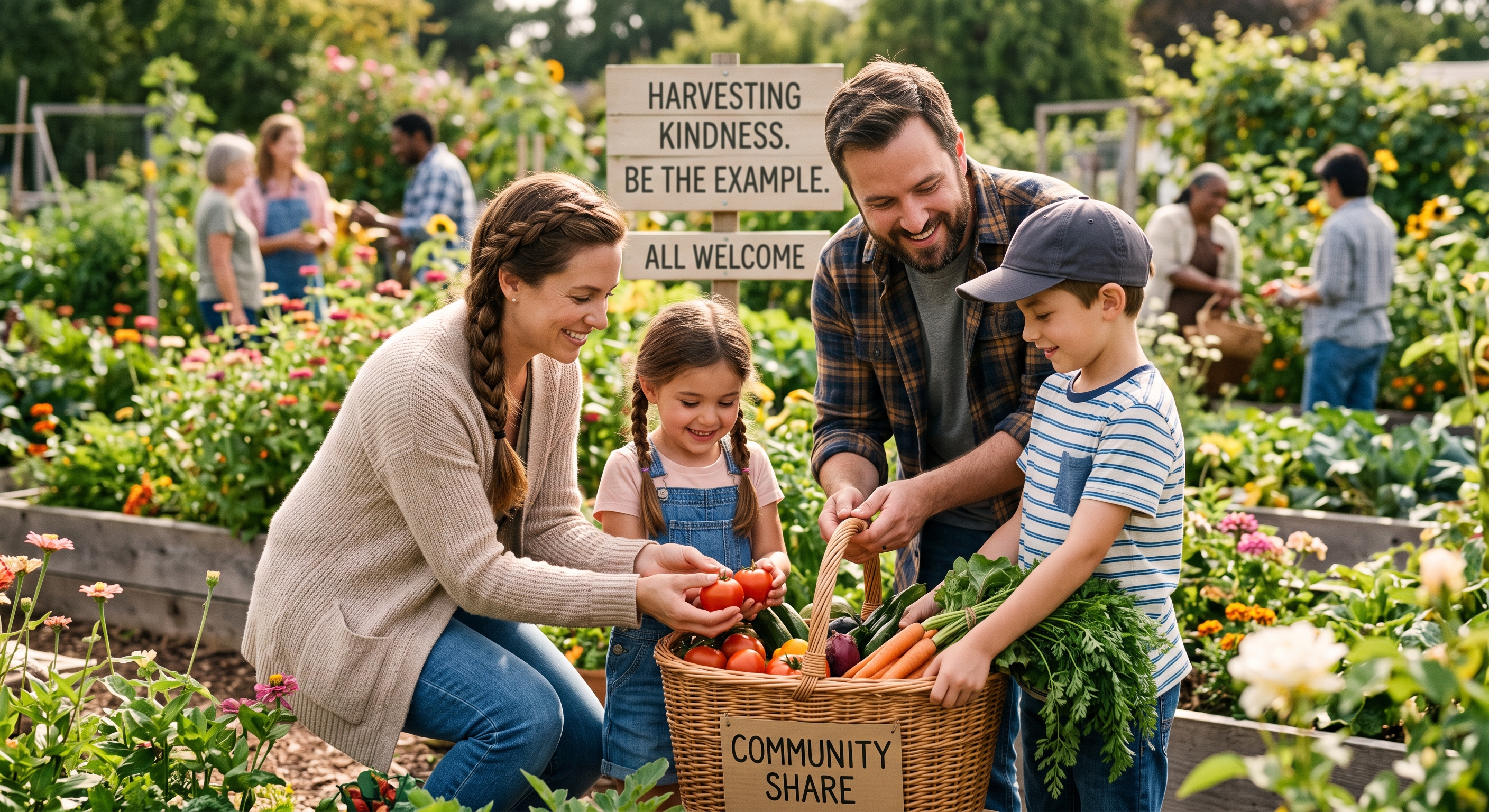
Children learn generosity far faster through participatory modeling—doing the work alongside you—than through lectures on charity. When introducing kids to community sharing (such as community gardens, food pantries, or neighborhood swap boxes), the goal is to shift their mindset from “giving away leftovers” to “active stewardship and connection.”
1. The Preparation: Give Them Tangible Ownership
- Involve them in the selection: Let children plant the seeds, pick the best produce, or select unopened items directly from the pantry rather than delegating whatever is left over.
- Define the purpose simply: Explain the tangible benefit: “We grew more tomatoes than we can eat, so we share the best ones so our neighbors can have fresh food too.”
2. The Action: Shoulder-to-Shoulder Participation
- Assign age-appropriate tasks: Toddlers can place vegetables into a basket; older kids can wash produce, write friendly recipe cards, or carry the crate to the distribution table.
- Model genuine warmth: Let your child see you greet neighbors, volunteers, and recipients with equal eye contact, respect, and enthusiasm.
3. The Reflection: Connect Action to Emotion
- Ask feeling-based questions: On the walk home, ask: “How did it feel to hand that basket over?” or “What was your favorite part of helping today?”
- Reinforce identity, not just behavior: Praise their character rather than just the deed: “You are someone who looks out for our community.”
Teaching based on age
Toddlers & Preschoolers (Ages 2–5): Sensory & Physical Helping
- Core Focus: Building the muscle memory of sharing and associating giving with joy.
- Activity:
- The “One for Us, One to Share” harvest: Have them drop one vegetable into the home basket and one into the community basket.
- Carry the Basket: Let them physically carry a lightweight item to the drop-off table or pantry bin.
- Key Phrasing: “Hands are for helping! Look how happy that bright red tomato makes our basket look.”
Early Elementary (Ages 6–9): Creative Ownership & Direct Action
- Core Focus: Understanding impact and taking responsibility for the presentation.
- Activity:
- Care Package Assembly: Let them wash produce, pack boxes, or decorate greeting cards and recipe cards to tuck inside the share baskets.
- In-Person Exchange: Encourage them to greet people at the community table or help place items directly onto the shelves.
- Key Phrasing: “When we share our best, it shows people that they matter to our neighborhood.”
Tweens & Teens (Ages 10+): Leadership & Logistical Responsibility
- Core Focus: Cultivating empathy, autonomy, and an understanding of mutual aid.
- Activity:
- Inventory & Planning: Involve them in tracking what the community share needs most (e.g., specific produce, shelf-stable goods, or care kits) and budgeting/shopping for those items.
- Shift Leadership: Give them a distinct role, such as organizing the share stand, managing collection bins, or helping run distribution for an hour.
- Key Phrasing: “Community isn’t just about where we live; it’s about how we take care of each other.”
Example Teaching Plan, Ages 2-5
The Weekly “Share Day” Routine for Ages 2–5
At this age, routines stick best when tied to clear sensory actions, simple songs or chants, and consistent physical cues.
Step 1: Prep & Sort (Mid-Week)
- The “One for Me, One for You” Game: Place two small buckets on the floor—one labeled “Home” (with a sticker of a house) and one labeled “Share” (with a heart or smiling face).
- Action: Hand your toddler items one by one (apples, seed packets, garden squash, or canned goods). Let them physically drop alternating items into the buckets while saying: “One for our kitchen, one for our friends!”
- Parent Cue: Keep it energetic and upbeat so giving feels like a fun sorting game rather than losing a possession.
Step 2: The Delivery Mission (Weekend)
- The “Special Helper” Job: Give them a dedicated, toddler-sized basket or lightweight tote bag containing 2–3 items to carry.
- The Ritual: Walk together to the community pantry, garden share stand, or collection bin.
- The Hand-off: Lift them up so they can physically place the items inside the bin themselves.
- Parent Cue: Say hello together to anyone nearby, modeling a warm smile and wave: “Good morning! We brought some good things to share today.”
Step 3: The 30-Second Connection (The Walk Home)
- Sensory Reflection: High-five right after the drop-off and connect the action to physical feelings:
- “Look at your strong helping hands!”
- “Did you see how bright those apples looked in the bin? It feels good to take care of our neighbors.”
Fun Activities to Go Along with Sharing
The Share Day Rhymes
Sing to the tune of “Twinkle, Twinkle, Little Star”:
Little hands can help today,
Sharing in a special way.
One for us and one for you,
Kind and helpful, through and through.
Little hands can help today,
Spreading smiles along the way!
Sing while walking to the bin (Tune of “The Wheels on the Bus”):
The helpers in our town share a helping hand,
Helping hand, helping hand.
The helpers in our town share a helping hand,
All through the town!
DIY Visual “Share Chart” (No Printer Needed)
Draw or print a 3-step icon track on a piece of cardboard or paper. Let your child place a sticker or draw a checkmark over each step on Share Day:
| Step | Visual Icon | Toddler Job |
| 1. Sort | 🧺 Two Baskets | Put items into the “Share” basket using “One for us, one to share.” |
| 2. Carry | 🚶 Footprints | Hold the basket handles all the way to the drop-off spot. |
| 3. Drop & Wave | 🍎 Smiling Apple | Place items into the bin and give a big wave to the neighborhood. |
Tips for Success with Toddlers
- Keep the weight light: If the basket is too heavy, their focus shifts from helping to frustration. Two apples or one small squash is plenty.
- Make the bin familiar: Let them peek inside the share box/pantry empty or full so the physical space feels friendly and predictable.
